
Contributing experts: Dr. Sarah Johnson, VP Head of Clinical Affairs at QIAGEN, and Bouchra Dufour, Lead Senior Manager, Data Management at QIAGEN
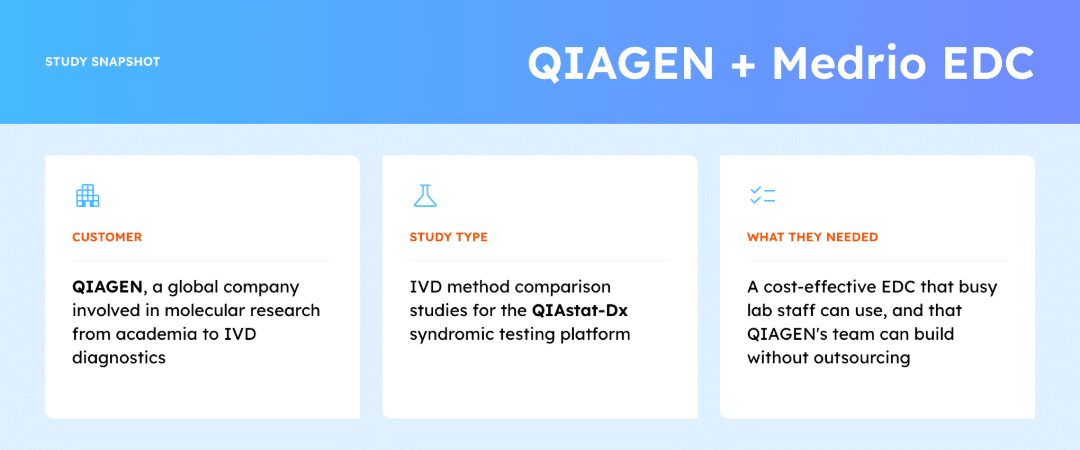
QIAGEN is a global life sciences and diagnostics company. Scientists around the world know it for its sample-preparation kits, a staple in research labs. QIAGEN also develops in vitro diagnostic (IVD) tests that labs use to diagnose a range of diseases.
One of those innovations is QIAstat-Dx, a syndromic testing platform. Instead of running dozens of separate tests, a lab adds a single sample to a single cartridge. The instrument then reports which pathogens are present.
QIAGEN needed an EDC built for diagnostic studies, one its own team could design and build. After evaluating six or seven providers, QIAGE chose Medrio EDC. The team used Medrio for its QIAstat-Dx Meningitis/Encephalitis Panel Plus study and has since started a second study, for a new panel.
Interested in having this story as a PDF? Download here.
A innovative study built in Medrio EDC
When investigating the cause of a meningitis infection, many hospitals rely on traditional culture, which often requires at least 24 hours of incubation. Meanwhile, patients need to wait for targeted treatment. QIAGEN provides new tests to make pathogen identification quicker.
In November 2024, the FDA cleared the QIAstat-Dx Meningitis/Encephalitis Panel for clinical use. Using a cerebral spinal fluid sample of less than 1 mL, it checks for 9 different pathogens. In the EU, an expanded panel is available that checks for 10 viral and 8 bacterial causes, with results in about an hour.
In April 2025, QIAGEN began a prospective and retrospective clinical study of the QIAstat-Dx Meningitis/Encephalitis Panel Plus in the United States. The team is capturing data in Medrio EDC.
The unique challenges of IVD trials
Diagnostic studies look very different from drug trials, and therefore have specific technology needs.
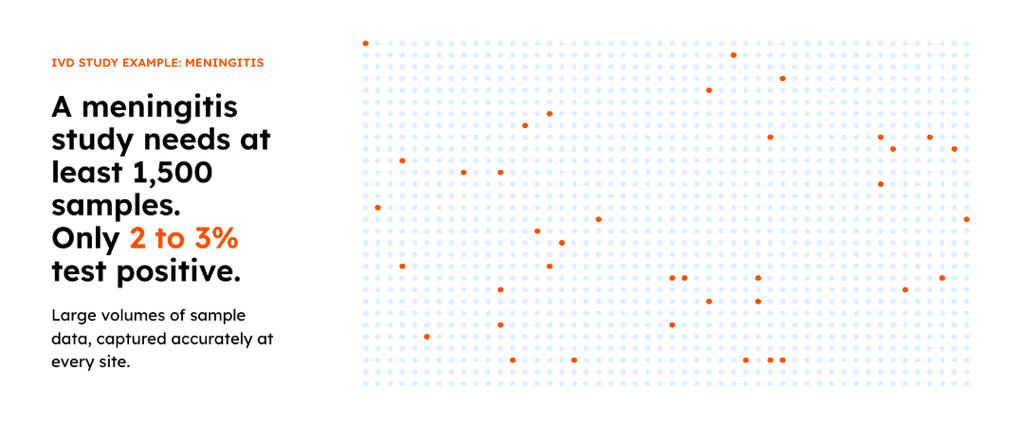
For example, a meningitis study needs at least 1,500 samples, and only 2 to 3 percent test positive. That means large volumes of sample data, captured accurately at every site.
When it came to choosing an EDC, QIAGEN faced three main challenges:
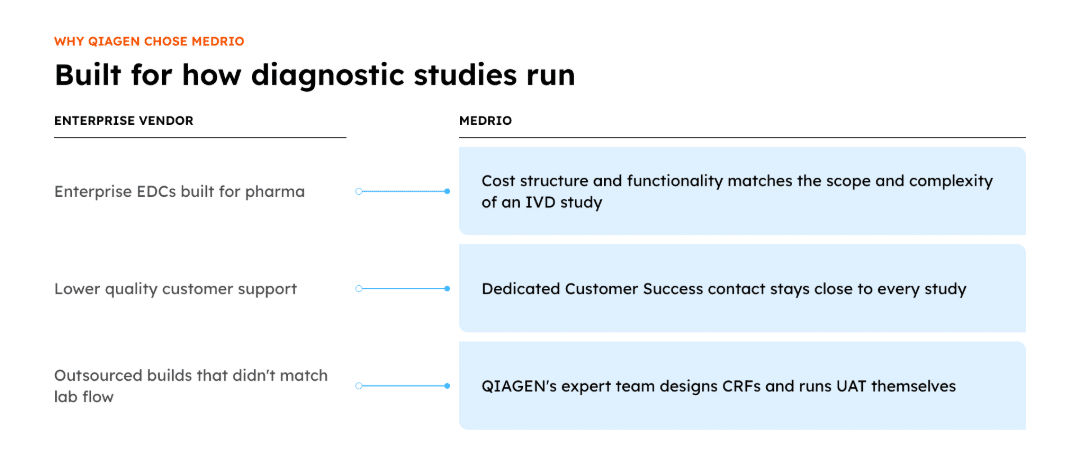
- Enterprise EDCs built for pharma: Many EDC platforms prioritize long, complex drug trials. Because diagnostic method comparison studies collect limited data, QIAGEN could end up paying for functionality they didn’t need.
- Busy labs with no dedicated study staff: QIAstat-Dx studies often run in working clinical labs. Lab operators enter data sample by sample, alongside their regular work. Any EDC had to be easy to learn and use without extensive training.
- Outsourced builds that didn’t match lab flow: Diagnostic studies are less common, so few outside specialists know how case report forms (CRFs) should function. When QIAGEN outsourced CRF design, the forms often didn’t match how samples move through a lab. That made data entry slow and cumbersome for site staff.
Why QIAGEN chose Medrio
Before contracting, Senior Lead Data Manager Bouchra Dufour evaluated six or seven EDC providers. She chose Medrio EDC. The clinical sites QIAGEN consulted also preferred Medrio.
“Being able to do it ourselves when we’re the IVD experts means that we can design the forms that work really well in the lab and work really well with a diagnostic.” — Dr. Sarah Johnson, VP Head of Clinical Affairs, QIAGEN
Four factors drove the decision:
- A right-sized EDC: Medrio EDC is fully validated and audit-ready, bringing both the clinical rigor and flexibility required. Its cost structure matches the scope and complexity of an IVD study.
- No-code study builds: QIAGEN’s expert data management team designs the CRFs and runs user acceptance testing. There’s no need for a programmer or an outsourced vendor.
- Easy to use for lab teams: Operators enter sample data as they go, alongside their regular lab work. The clinical sites QIAGEN consulted before choosing an EDC said they preferred Medrio.
- High-touch partnership: Medrio’s team supports each new build, offering guidance when needed. A dedicated Customer Success contact stays close to every study.
The benefits of a right-sized EDC for IVD studies
Medrio EDC helps QIAGEN run diagnostic studies efficiently, from build to database lock. With Medrio, QIAGEN pays for what an IVD study needs, not for features built for pharma.
Because QIAGEN designs its own forms, data entry follows how IVD studies run in the lab. And because sites, CRAs, and QIAGEN’s own team now know the platform, each new study starts on familiar ground.
“[Medrio EDC] has to be something that’s usable in busy laboratories where they can enter their data as the study is going along on a daily basis or sample by sample basis.” — Dr. Sarah Johnson, VP Head of Clinical Affairs, QIAGEN
Supporting tomorrow’s science
QIAGEN has started its second Medrio study, for a new QIAstat-Dx panel. At Medrio, we’re proud to support that work as we build toward a world where no disease goes untreated.
What to see what Medrio can do for you? Request a demo.