

Many teams still track site payments in spreadsheets and through email. But as studies add sites, countries, and protocol amendments, those manual processes become harder to manage.
A site payment system can work alongside a connected EDC and CTMS to tie payments to study activity. This can help sponsors and CROs increase payment status visibility and pay sites accurately and on time.
In this article, you’ll learn about the:
- Definition of site payments
- Challenges of managing site payments
- Definition of site payment technology
- Ways site payment systems support trial operations
- Main users of site payment systems
- Benefits of technology for site payments
- Common questions about site payment software
Interested in getting in early with Medrio’s Site Payments? See our program.
What are site payments in clinical trials?
Clinical trial site payments are the funds that sponsors and CROs pay research sites for completing study activities. For example, these activities can include milestones tracked in CTMS and participant visits logged in EDC.
Sites depend on accurate, on-time payments to cover staff, overhead, and participant costs. When payments run late or arrive with errors, site relationships suffer, and study timelines can be delayed.
What are the challenges of managing site payments?
Site payment management involves clinical data, contracts, and finance. Each site has its own payment terms, schedules, and currency considerations. Keeping everything on track takes coordination across several teams.
Common site payment challenges include:
- Confirming payment accuracy: Without shared visibility, clinical operations teams and sites exchange countless emails to confirm what’s been paid and why. Tracking can be time consuming and confusing.
- Reconciling visit data: Matching completed visits against each site’s budget takes time and can introduce errors.
- Handling site-specific budgets: Each site may need its own payment rules, holdback, and overhead calculations. Teams must also reconcile amendments, screen failures, and conditional procedures against payments already made.
- Processing pass-through costs: Sites submit pass-through costs, like participant travel reimbursements, through multiple channels. Processing each one requires knowing that site’s negotiated terms.
- Building forecasts: Payment forecasts can take hours of reconciliation across multiple spreadsheets and teams.
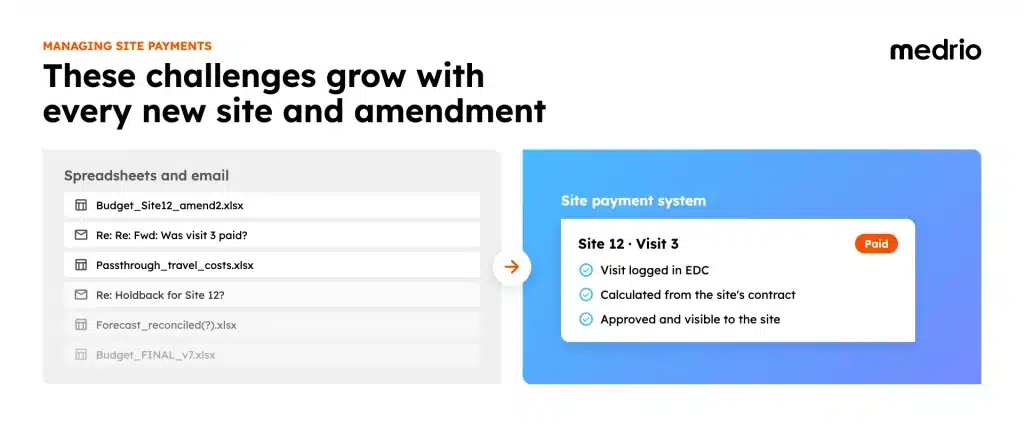
These challenges grow with every new site and amendment. The right solution for site payments turns these manual steps into a repeatable process.
When used alongside a CTMS or EDC, it becomes easier to track payments and send them on time to keep studies moving forward.
What is site payment technology?
Site payment technology is software that sponsors and CROs use to calculate, approve, and track payments to clinical trial sites. It may also be called site payment software, a site payment system, or a clinical trial payment management solution. No matter what it’s called, this technology creates efficiencies by connecting site payments to completed study activity.
How do site payment systems support clinical trial operations?
A site payment system supports trial operations by linking study activity to the payments it triggers.
For example, a site may screen a participant, complete a follow-up visit, or close out the study. Each activity can trigger a payment based on the site’s contract. The system calculates the amount owed, routes it for approval, and records each step.
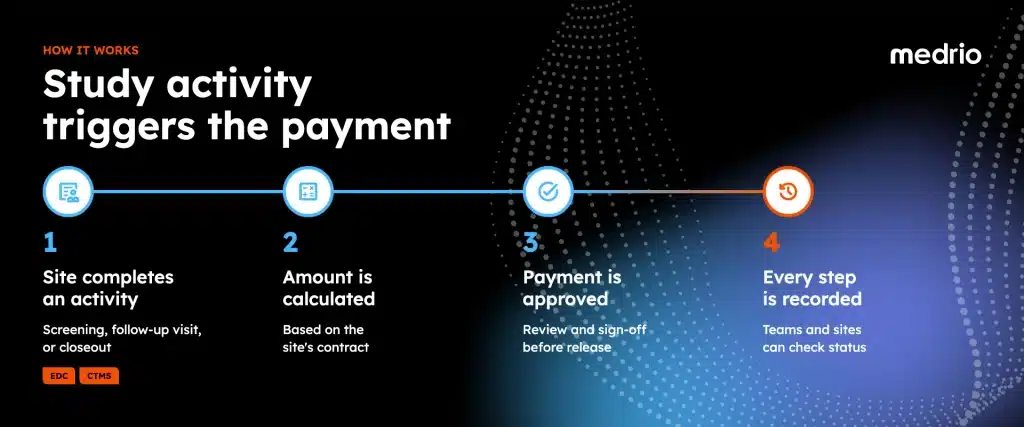
A site payment system supports operational work through:
- Budget configuration: Teams set each site’s contracted rates and payment terms once, at study startup.
- Activity-based calculations: Visit and procedure data from the EDC determines payment amounts.
- Approval workflows: Payments move through review and sign-off before release.
- Payment tracking: Teams can see each site’s earnings and payments, as well as which payments are approved or held back.
- Site access: Sites can be given limited viewing access to check their payment status, reducing back-and-forth emails.
Who uses site payment systems?
Sponsors and CROs are the primary owners of site payment systems. Research sites may also use them to check payment status or confirm payments.
Common site payment system users include:
- Clinical operations teams: Confirm completed study activities and oversee site relationships.
- Finance and accounts payable teams: Approve, release, and reconcile payments.
- Contracts and budgeting teams: Set up site budgets and update them after amendments.
- CRO project managers: Manage payments across multiple sponsors and studies.
- Site staff: Track what they’ve earned and when payments will arrive.
What are the benefits of technology for site payments?
The benefits of site payment technology include more predictable payments, fewer errors, stronger site relationships, and better financial visibility.

More predictable payments. Site payment technology can tie payments to completed activities, so sites get paid on a consistent schedule. This reliability means sites can plan staffing and cash flow with more confidence.
Fewer errors. Calculating payments from study data reduces manual entry and the associated errors. This accuracy means that teams spend less time correcting overpayments and missed payments.
Stronger site relationships. Accurate, on-time payments show sites that their work is valued. Satisfied sites are more likely to stay engaged and take on future studies.
Better financial visibility. Sponsors and CROs can see accruals, forecasts, and outstanding balances across studies. That visibility supports budget planning and reporting.
Interested in getting in early with Medrio’s Site Payments? See our program.
Frequently asked questions about site payment software
What is site payment software?
Site payment software is a system sponsors and CROs use to calculate, approve, and track payments to research sites. It replaces spreadsheets and email with a structured, auditable process.
Can site payment software connect to an EDC or CTMS?
Yes. Site payment software can use visit data from an EDC, which reduces duplicate entry across systems.
When do sponsors and CROs need site payment software?
Teams typically adopt site payment software when spreadsheets can no longer keep up. Common triggers include adding sites, running multiple studies, or managing frequent protocol amendments.