

Updated on: September 16, 2026
Contributing Expert: Tina Caruana, Director of eClinical Solutions
TL;DR: AI regulation in clinical trials moved from proposals to real deadlines this year. The FDA, EMA, MHRA, Health Canada, and China’s NMPA all published new AI guidance in 2025 and 2026. Additionally, the EU AI Act’s high-risk rules now sit on a fixed timeline.
Artificial intelligence (AI) has enormous potential to revolutionize clinical trial research. But first, the industry must agree on how to regulate its use. Industry bodies, federal agencies, lawmakers, and even investors are weighing in on how to regulate AI within clinical research.
The stakes are high for effectively regulating AI in clinical trials. If done well, AI could unlock new drug discoveries at a previously unimagined pace.
However, if done poorly, applying AI in clinical trials could introduce unprecedented risk. Therefore, regulators must find a way to mitigate risk while supporting innovation and progress.
This article covers the current state of AI regulation in clinical trials, updated as of August 2026.
In this article:
- Why AI regulation in clinical research is evolving
- AI regulatory frameworks by country: USA, EU, UK, Canada, and China
- Joint international efforts to align AI guidance
- What AI regulations mean for sponsors and CROs
- What’s next for AI in clinical research
Looking to incorporate AI in your next trial? Make sure you’re asking the right questions with our AI key questions infographic.
Please note this article is not comprehensive but highlights key regulatory developments through August 2026.
Evolving artificial intelligence regulations in clinical research
As regulatory bodies race to keep up with AI development, many have developed stringent requirements to prioritize patient safety and ethical conduct in clinical trials.
In general, global regulatory guidelines emphasize data:
- Integrity
- Accuracy
- Transparency
AI is increasingly integrated in other areas under regulatory bodies’ jurisdiction, such as Digital Health Technologies (DHTs) and Real-World Data (RWD) analytics. Therefore, it is crucial for clinical researchers to stay informed of all relevant angles as they contemplate incorporating AI into a trial.
Consider the current state of:
- USA’s AI regulatory guidance for clinical trials
- EU and UK’s AI regulatory guidance for clinical trials
- Canadian AI regulatory guidance for clinical trials
- China’s AI regulatory guidance for clinical trials

USA’s AI regulatory guidance for clinical trials
The United States Food and Drug Administration (FDA) has taken a flexible, risk-based approach to regulating AI within clinical research.
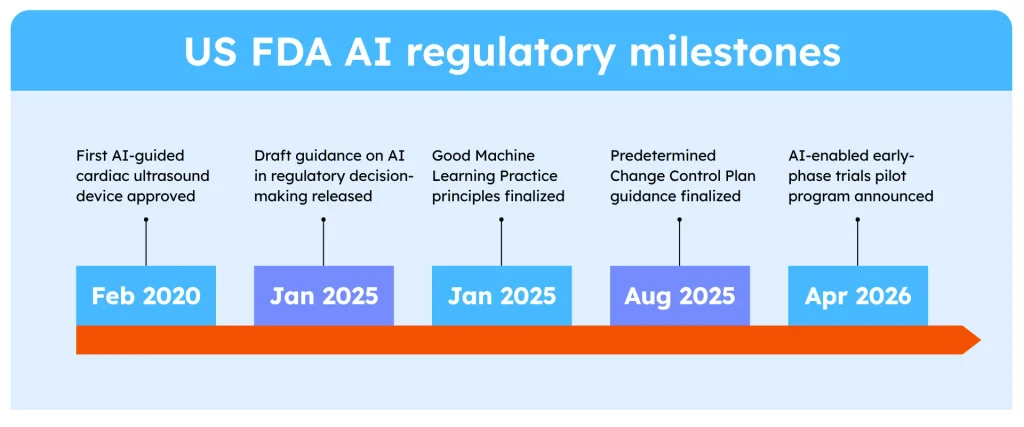
On February 7, 2020, the FDA announced its approval of the first cardiac ultrasound software, which uses artificial intelligence to guide users. Since then, the FDA “has accelerated its efforts to create an agile regulatory ecosystem that can facilitate innovation while safeguarding public health.”
As part of its efforts, the agency has developed a glossary of relevant digital health and AI terms.
US drug development: AI/ML guidance
The FDA “recognizes the increased use of AI/ML throughout the drug development life cycle and across a range of therapeutic areas.” The FDA has approved over 1,000 AI-based medical devices as of late 2024. Submissions with AI/ML components keep climbing.
Current AI/ML drug development documentation includes:
- FDA’s AI in Drug Development hub
- The FDA’s central, continuously updated resource for AI-related guidance, discussion papers, and initiatives across drug and biologic development.
- Considerations for the Use of Artificial Intelligence To Support Regulatory Decision-Making for Drug and Biological Products
- Draft guidance released in January 2025 which introduces a 7-step, risk-based credibility assessment framework for AI models used in safety, effectiveness, or quality decisions. The public comment period closed April 7, 2025, and final guidance is expected in 2026.
- AI-Enabled Optimization of Early-Phase Clinical Trials pilot program
- A Request for Information published in April 2026 about a new FDA pilot exploring how AI can improve early-phase trial design.
- AI/ML for Drug Development Discussion Paper and Request for Feedback
- This discussion paper outlines the FDA’s early thinking on where AI/ML fits across the drug development lifecycle. Revised in February 2025, it invites public feedback to help shape future guidance.
US medical devices: AI/ML guidance
The FDA states, “The complex and dynamic processes involved in the development, deployment, use, and maintenance of AI technologies benefit from careful management throughout the medical product life cycle.” The FDA has built out a growing library of guidance to support decision-making.
Recent AI/ML medical device documentation includes:
- Marketing Submission Recommendations for a Predetermined Change Control Plan for Artificial Intelligence/Machine Learning (AI/ML)-Enabled Device Software Functions
- Final guidance released in August 2025 that finalizes the pathway first drafted in April 2023, letting manufacturers pre-authorize planned model updates.
- Artificial Intelligence and Medical Products: How CBER, CDER, CDRH, and OCP are Working Together
- A paper originally published in March 2024 and revised in February 2025 that explains how the FDA’s centers coordinate oversight of AI-enabled drugs, biologics, and medical devices.
- Artificial Intelligence-Enabled Device Software Functions: Lifecycle Management and Marketing Submission Recommendations
- Draft guidance released in January 2025 that covers labeling, transparency, and real-world performance monitoring expectations for AI-enabled devices.
- Good Machine Learning Practice (GMLP) Guiding Principles
- An IMDRF final document published in January 2025 that builds on the FDA’s, Health Canada’s, and MHRA’s 2021 principles into an internationally endorsed standard.
Of note, the FDA also has several comprehensive web pages dedicated to Software as a Medical Device (SaMD).
European Union and United Kingdom AI regulatory guidance in clinical trials
There is no current legislation specifically about the use of AI in clinical trials in the European Union (EU) or the United Kingdom (UK). There are, however, several factors sponsors need to consider. Both regions are layering AI rules on top of existing medical research and device frameworks.
EU guidelines: AI/ML
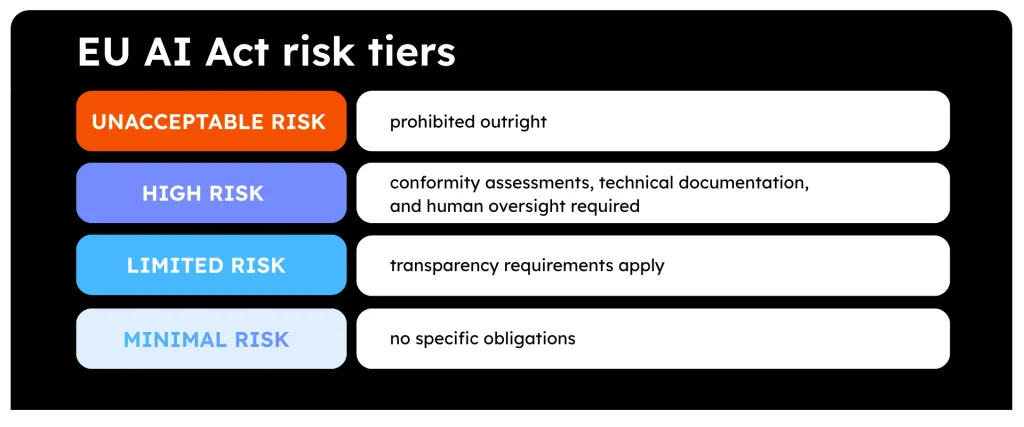
Currently, any AI used within a clinical trial in the EU needs to comply with the EU AI Act adopted by the European Parliament in 2023. The AI Act was established to comprehensively regulate AI systems across industries in the EU. Most of the Act’s provisions are now in force, and enforcement began in August 2025.
The AI Act takes a risk-proportionate approach with four levels of AI systems, ranging from minimal to unacceptable. Medical devices sit in the “high-risk” tier and face the strictest requirements.
Relevant considerations include:
- Article 50 has required AI disclosure since August 2, 2026. This article is for any system that interacts with people, including clinical documentation tools and patient-facing assistants. This requirement is true whether or not the tool is classified as high-risk.
- Regulation (EU) 2026/1744, which took effect July 27, 2026. It pushed the high-risk compliance deadline for standalone AI systems to December 2, 2027. The deadline for AI embedded in regulated products, like medical devices and IVDs is now August 2, 2028.
The European Medicines Agency (EMA) still hasn’t written AI-specific clinical research rules, but its published positions carry real weight.
The European Medicines Agency (EMA) published:
- European Medicines Agency: Reflection Paper on the Use of Artificial Intelligence (AI) in the Medicinal Product Lifecycle
- A draft reflection paper, released in July 2023 and finalized in September 2024, that sets out EMA’s current thinking on the use of AI. It examines AI usage throughout a medicine’s lifecycle, from drug discovery to post-authorization.
- Guiding Principles of Good AI Practice in Drug Development
- A joint FDA-EMA document published in January 2026 that aligns US and EU expectations for AI across the medicine lifecycle. It examines the use of AI from early research through post-market safety monitoring.
To learn more about AI in clinical trials, read The EU AI Act Is Here — What It Means for Clinical Trials.
UK guidelines: AI/ML
The UK has kept a pro-innovation, principles-based stance. This approach leaves the Medicines and Healthcare products Regulatory Agency (MHRA) discretion over how the principles apply to clinical research.
Relevant AI/ML documents:
- Software and Artificial Intelligence (AI) as a Medical Device
- Guidance document updated in February 2025 that explains when software and AI qualify as a medical device under UK law. It also outlines how manufacturers should approach compliance.
- Impact of AI on the Regulation of Medical Products
- A policy paper published in April 2024 setting out the MHRA’s early thinking on how AI is reshaping the regulation of medicines and medical devices.
- AI Airlock Expansion
- A regulatory sandbox update from April 2026. MHRA secured £3.6 million over three years to extend its AI Airlock program for AI-as-a-medical-device (AIaMD) developers into real-world testing.
- Guidance on Ambient Voice Technology-Enabled Products
- Guidance published on July 29, 2026, clarifying that AI scribes used only for transcription or summarization aren’t medical devices. Explains how the tool must serve a genuine medical purpose, such as suggesting a diagnosis, to be regulated as one.
- Draft Medical Devices (Amendment) Regulations 2026
- A draft regulation published May 8, 2026, proposing an International Reliance Pathway for devices already approved in the US, Canada, or Australia. Lays out a formal Predetermined Change Control Plan route for AI and software devices.
Canadian AI regulatory guidance for clinical trials
Canada still doesn’t have a cross-sector AI law. The proposed Artificial Intelligence and Data Act (AIDA) was never enacted into law. This means AI-enabled clinical tools continue to be regulated as medical devices under the existing Food and Drugs Act and Medical Devices Regulations.
Relevant documents include:
- Pre-market Guidance for Machine Learning-Enabled Medical Devices
- Finalized February 5, 2025, and republished April 1, 2026. Introduces a Predetermined Change Control Plan (PCCP) mechanism so manufacturers can pre-authorize planned model updates. It also sets clinical evidence expectations across sex, gender, and underrepresented populations.
China’s AI regulatory guidance for clinical trials
China is a major producer and consumer of medical devices and a hub for much healthcare–related software development. Therefore, authorities recognized the need for comprehensive regulatory guidance, particularly for international manufacturers.
The National Medical Products Administration (NMPA), China’s regulatory body for clinical research, continues to take a cautious approach towards AI-empowered medical devices.
- Announcement of the National Medical Products Administration on Issuing Measures to Optimize Whole Life-Cycle Regulation in Support of the Innovative Development of High-End Medical Devices ([2025] No. 63)
- Published June 27, 2025, this document sets a broad policy roadmap for AI-powered medical devices, medical robots, and other emerging technologies. It covers simplified registration for AI algorithm updates, the development of new AI-specific standards, and adverse event reporting requirements for AI devices.
- “Implementation Opinions on Artificial Intelligence + Drug Regulation”
- Published April 2, 2026, this document sets a long-term roadmap through 2030 and 2035. It covers using AI in the review, inspection, and supervision of drugs, devices, and cosmetics.
- Draft Guideline on Clinical Evaluation of AI-Assisted Diagnostic Medical Devices
- Released June 17, 2026, with comments closing July 10, 2026. Covers Class III AI tools that characterize lesions in medical images, such as pulmonary, thyroid, and breast nodule evaluation.
The NMPA continues to emphasize data sufficiency, diversity, and bias mitigation in AI algorithm development.
Joint international efforts to align AI guidance
As regulatory bodies strive to make progress in regulating AI, some groups are combining forces.
In 2020, SPIRIT-AI and CONSORT-AI were created as part of an international collaborative effort to improve the transparency and completeness of clinical trials evaluating interventions involving AI.
These documents are extensions of the existing SPIRIT (Standard Protocol Items: Recommendations for Interventional Trials) and CONSORT (Consolidated Standards of Reporting Trials). Both documents sought to provide minimum guidelines for protocols and reporting for randomized trials, respectively.
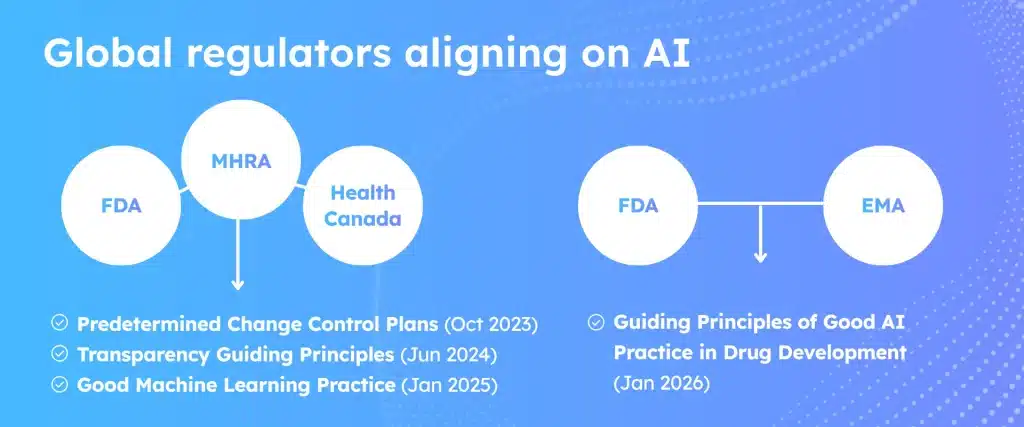
The FDA, Health Canada, and the MHRA have kept working together on shared guidance, including
- Predetermined Change Control Plans for Machine Learning-Enabled Medical Devices: Guiding Principles
- Published October 2023. A joint FDA, Health Canada, and MHRA guidance document that outlines a shared approach to letting manufacturers pre-authorize planned AI/ML model updates without new marketing submissions.
- Transparency for Machine Learning-Enabled Medical Devices: Guiding Principles
- Published June 2024. A joint FDA, Health Canada, and MHRA guidance document setting shared expectations for how manufacturers should disclose information about their AI/ML devices to users and patients.
- Good Machine Learning Practice (GMLP) Guiding Principles
- Finalized January 2025 by the IMDRF, building the tri-agency’s original 2021 principles into a broader, internationally endorsed 10-point standard for AI/ML medical devices.
- Guiding Principles of Good AI Practice in Drug Development
- Published January 2026 as joint FDA and EMA guidance. Ten shared principles aligning US and EU expectations for AI across the medicine lifecycle, from early research through post-market safety monitoring.
What these AI regulations mean for sponsors and CROs
Regulatory momentum is real, but the details still vary a lot by region and product type.
Practical takeaways include:
- Map your AI use case to a framework early. Identify whether your tool touches safety, efficacy, or data quality decisions. This definition determines which guidance applies to you.
- Expect more documentation, not less. Every major regulator now expects some form of change-control plan, bias assessment, and lifecycle performance monitoring for AI models.
- Track deadlines by product type, not by headline. AI tools, features, and models used in drug development can each fall under different rules and deadlines, even within the same region. Check which category your product falls into.
- Build in transparency from day one. Sponsors should be able to explain what an AI tool does, what data trained it, and where a human reviews its output.
- Watch for regional divergence. The US, EU, UK, Canada, and China aren’t converging on a single AI rulebook. Each region is moving at its own pace and with its own priorities. Sponsors running multi-region trials may need to map requirements region by region to remain compliant.
What’s next for AI in clinical research
The world of AI is moving fast. The intersection of large language models (LLMs), machine learning (ML), and evolving algorithms presents thrilling new possibilities within clinical research.
Meanwhile, AI regulation has moved faster than most people expected. In under two years, guidance went from discussion papers to binding, calendar-based deadlines. Debate over how much to regulate AI will continue.
Sponsors should expect more guidance over the next few years, as regulators refine these early frameworks with real-world experience.
Medrio’s experts have decades of experience navigating the changing clinical trial environment amidst evolving regulatory guidelines. Our experts are equipped with innovative and creative solutions to help you keep pace. Connect with us at medrio.com/contact-us/.
Looking to incorporate AI in your next trial? Make sure you’re asking the right questions with our AI key questions infographic.