

Contributing experts at Medrio: Laurin Wiletts, Strategic Partner and Tina Caruana, Director of eClinical Solutions
An electronic trial master file (eTMF) is a digital system used to store, organize, track, and manage the essential documents and records required for a clinical trial.
When an auditor, inspector, sponsor, or partner asks to review study documentation, teams need more than a folder full of PDFs. They need a structured, validated, inspection-ready source of truth.
A well-managed eTMF helps teams prove what happened during a study, when it happened, and who approved it. It also shows whether the trial was conducted according to protocol, Good Clinical Practice, and applicable regulatory requirements.
In this article, you will learn about the:
- Purpose of an eTMF.
- Challenges of clinical trial file management.
- Ways eTMF supports clinical trial operations.
- Main users of an eTMF.
- Benefits of an eTMF.
- Differing eTMF needs depending on organization type and study size.
- Integrations between eTMF and EDC.
- Common questions asked about eTMF.
Learn more about what Medrio eTMF can do for you. Request a demo.
What is an eTMF?
An eTMF, or electronic trial master file, is the digital version of the trial master file. It houses the essential documents and records. An eTMF shows a clinical trial was planned, conducted, monitored, and closed according to the protocol and applicable regulatory expectations.
Learn more about Medrio eTMF here.
What are the challenges of clinical trial file management?
Historically, trial master files were physical binders stored in filing rooms. Some teams still work with paper for certain records, but many organizations have already moved to electronic storage.
The challenge is that basic cloud storage is not the same as an eTMF.
A shared drive may store files electronically, but it typically lacks critical components of a purpose-built eTMF. These components include structure, metadata, audit trails, version control, user permissions, workflows, completeness tracking, and inspection-readiness dashboards.
Clinical trial teams need a system that can prove their trial records are complete, current, traceable, accurate, and inspection-ready. This approach means they are always compliant and audit-ready.
How does an eTMF support clinical trial operations?
An eTMF supports clinical trial operations by connecting study activities to the documentation that proves those activities occurred.
For example, a study team may activate a site, complete investigator training, perform a monitoring visit, approve a protocol amendment, or close out a site. Each of those activities produces essential records. The eTMF stores those records in a compliant and structured way so clinical operations teams can find, review, approve, and produce them when needed.
A well-designed eTMF supports operational work through:
- Centralized document management.
- Document version control.
- Audit trails.
- Missing document tracking.
- Real-time oversight.
eTMF vs CTMS
A CTMS system is often used alongside an electronic trial master file (eTMF), but the two serve different purposes.
- CTMS: Tracks operational activities and study management tasks
- eTMF: Stores the regulatory documents and essential records that prove those operational activities and management tasks occurred
For example, the CTMS may track when a site monitoring visit is scheduled or completed. The eTMF stores the monitoring visit report, follow-up letter, and related documentation.
During site activation, a CTMS may track site startup milestones, contracts, feasibility, enrollment status, monitoring plans, and payments. Meanwhile, the eTMF stores the documents that support those activities, such as signed contracts, CVs, licenses, training records, approvals, and correspondence.
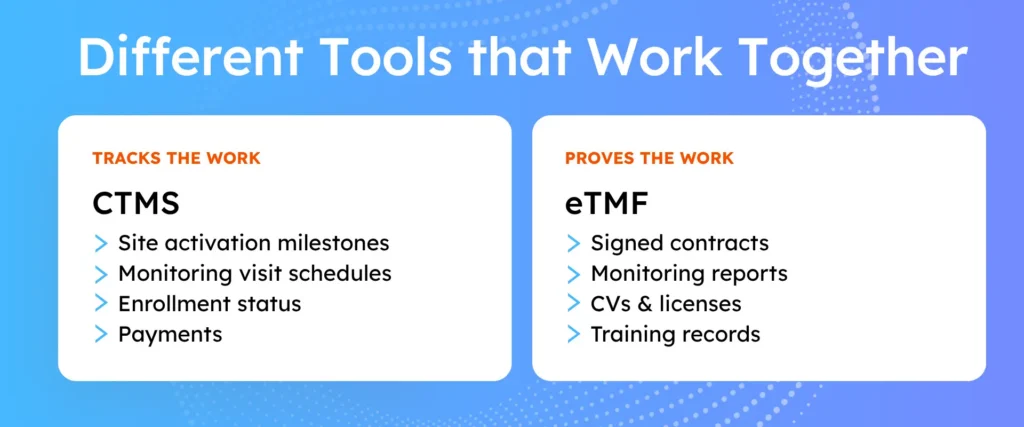
Together, CTMS and eTMF systems give sponsors and CROs operational oversight and regulatory documentation. When integrated, these tools help clinical trials run more efficiently while supporting compliance and inspection readiness.
Learn more about Medrio CTMS.
Who uses eTMF?
The eTMF is primarily used by sponsors and CROs, especially clinical operations teams.
Common eTMF users include:
- Clinical trial managers
- Clinical research associates
- Study leads
- Project managers
- Regulatory affairs teams
- Quality assurance teams
- Data management and biostatistics contributors
- CRO oversight teams
- Sponsor oversight teams
- Auditors and inspectors with controlled access
What are the benefits of eTMF?
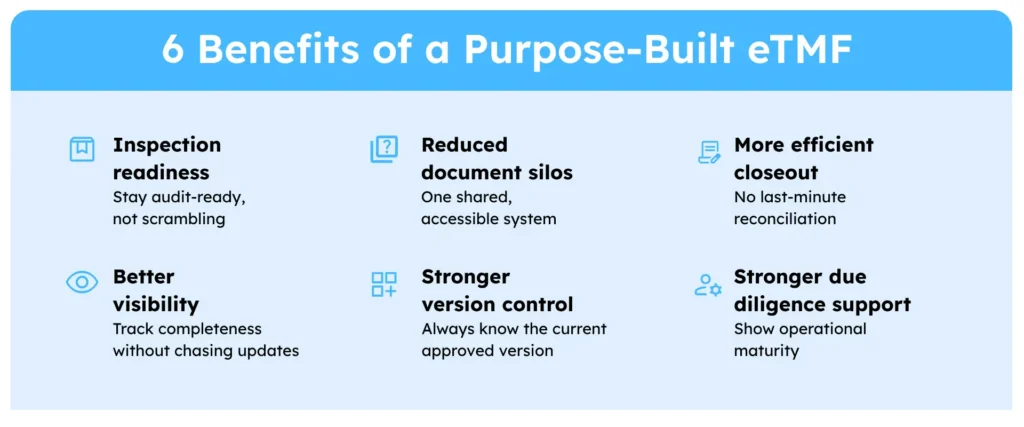
The benefits of eTMF include stronger compliance readiness, better document control, improved collaboration, reduced risk, and more efficient study oversight.
- Inspection readiness: A purpose-built eTMF helps teams maintain documentation throughout the trial rather than waiting until closeout to reconcile gaps. This makes it easier to respond to audits, inspections, and due diligence requests with complete, current records.
- Better visibility: Study leaders can track TMF completeness, document status, overdue reviews, and missing records without chasing updates across emails, spreadsheets, or shared folders.
- Reduced document silos: An eTMF gives authorized sponsors, CROs, and study team members a shared place to access essential documents, reducing the risk that important records sit with one person, vendor, or department.
- Stronger document version control: Clinical trial documents change often. An eTMF helps preserve superseded versions, identify the current approved version, and maintain a clear record of document history.
- More efficient closeout: When documents are filed and reviewed throughout the study, teams can avoid the last-minute scramble to locate, clean up, or reconcile missing records at closeout.
- Better support for due diligence: A clean, structured eTMF helps emerging sponsors demonstrate operational maturity to investors, partners, acquirers, and regulators.
How eTMF needs differ by organization and study size
Not every organization needs the same eTMF configuration. Small and scaling clinical teams need a different setup than a global sponsor running large, multi-country studies.
Nimble teams need a practical, structured, compliant eTMF that is easy to implement, easy to use, and appropriately scaled to the studies they run.
- Small and emerging sponsors: These teams need an eTMF that gives them visibility into essential documents, supports sponsor oversight, and keeps study records inspection-ready. The right system should help them move beyond shared drives, spreadsheets, or disparate folders while maintaining control over documentation quality.
- CROs: CROs need repeatable eTMF processes across multiple sponsors, studies, therapeutic areas, and study teams. A strong eTMF should support reusable file structures, study-specific configuration, role-based access, quality review workflows, and clear metrics. This helps CROs show sponsors that documentation is complete, current, and managed consistently from startup through closeout.
- Scaling clinical teams: Small clinical teams may have one person managing site startup, monitoring, vendor oversight, documentation, and reporting. As the team scales operations, an eTMF can support their workload to make it clear what needs to be filed and where it belongs. The right setup shows what is missing and what needs review, without adding complexity.
How do eTMF and EDC work together?
Electronic data capture (EDC) collects the clinical data generated during a study. eTMF stores the essential documents that prove key study activities were completed and managed appropriately.
When the two systems work together, clinical activity can help prompt the documentation workflows needed to keep the trial master file complete and inspection-ready.
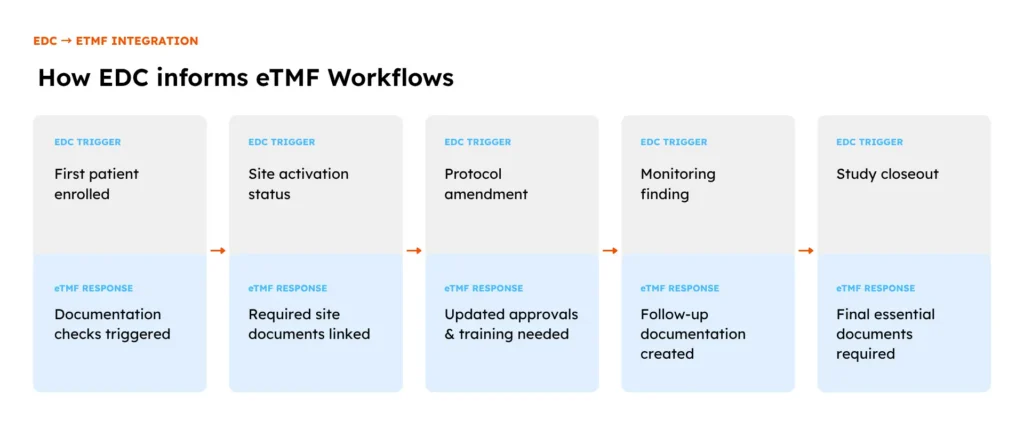
EDC activity can trigger or inform eTMF workflows:
- First patient enrolled may trigger documentation checks.
- Site activation status may connect to required site documents.
- Protocol amendments may require updated approvals, training, and consent materials.
- Monitoring findings may create follow-up documentation.
- Study closeout activities may require final essential documents.
When eTMF, CTMS, and EDC are connected, teams can reduce manual handoffs and keep operational data aligned with regulatory documentation.
Learn more about Medrio EDC.
Medrio eTMF: Streamlining Clinical Trial Execution
The right eTMF can support teams that want to move beyond disconnected folders, spreadsheets, and manual document tracking. It supports a structured, inspection-ready process.
Medrio’s approach is designed to support practical clinical trial execution across connected systems. When eTMF works alongside CTMS and EDC, teams can bring study operations, clinical data, and essential documentation closer together.
Learn more about Medrio’s eTMF. Request a demo.
Frequently asked questions about eTMF
Why is eTMF important for compliance?
An eTMF supports compliance by helping teams maintain complete, accurate, current, and traceable records. It also supports audit trails, version control, access controls, and inspection readiness.
What are essential documents in an eTMF?
Essential documents are records that allow evaluation of clinical trial conduct and data quality. Examples include protocols, informed consent forms, investigator brochures, approvals, training records, monitoring reports, contracts, and closeout documentation.
What is the eTMF Reference Model?
The eTMF Reference Model, now part of the CDISC TMF Standard, provides a commonly used structure and terminology for organizing trial master file content.
Does an eTMF replace an investigator site file?
No, the sponsor or CRO eTMF and the investigator site file serve related but distinct purposes. The site file contains records that the site needs to maintain for its own responsibilities and regulatory compliance.
Can eTMF integrate with EDC?
Yes. eTMF and EDC integration can help connect clinical data activities with required documentation workflows. For example, enrollment, protocol amendments, site activity, or study closeout events may trigger eTMF tasks.
Can eTMF integrate with CTMS?
Yes. eTMF and CTMS integration is common because CTMS tracks operational activities while eTMF stores the documentation that supports those activities.
What are common eTMF implementation mistakes?
Common mistakes revolve around thinking of the eTMF as a digital filing cabinet rather than a software-supported quality process. As a result, issues arise like unclear ownership, underestimating change management, poor data migration planning, overcomplicated or scant folder structures, limited training, and failure to monitor completeness and quality after go-live.