

Contributing Medrio experts: Muhammad Bilal, VP Clinical Data Services; Rod McGlashing, Data Science Subject Matter Expert; and Jack Cornwall, Principal Solutions Consultant
Clinical data management is changing. The work is moving away from manual tasks and toward strategic decision-making. Some clinical trial data management teams are embracing change faster than others, but the direction is clear.
To better understand these changes, Medrio conducted qualitative research with clinical data management professionals. We asked about career paths, shifting responsibilities, important skills, AI, and advice for other professionals.
The research revealed four clear trends, two of which are covered in this blog. In this article, we’ll explore:
- How the research was conducted.
- What AI is changing for clinical data management careers.
- Why data management now requires a hybrid skill set.
Download the full report to read about all four trends in-depth, including specific actions you can take to stay ahead.
About the CDM research
Our goal was to capture a representative cross-section of the life sciences landscape so that the data reflects a qualified and balanced group of industry professionals.
Medrio collected long-form written and video responses from 63 professionals working in clinical trial data management. Respondents represented 45 unique job titles across 13 industry segments.
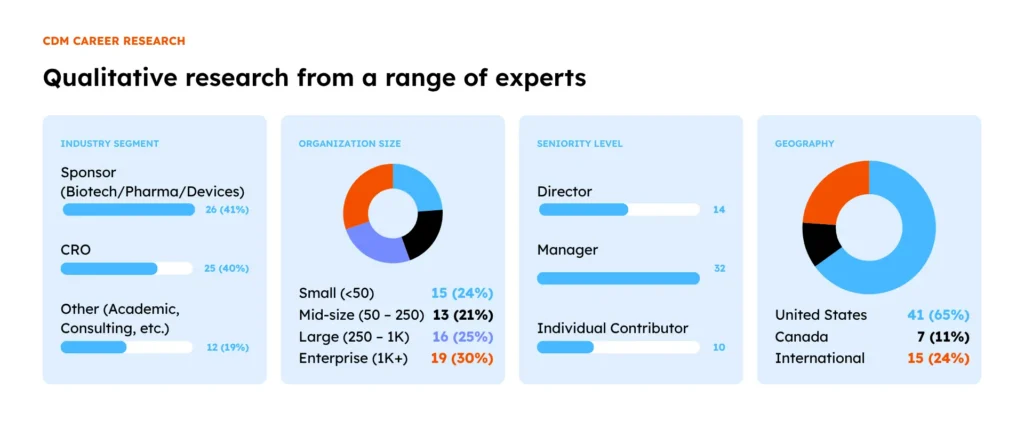
Representation: Industry segment and company size
For industry segment representation, there was an almost identical split between sponsors at 41% (26 respondents) and CROs at 40% (25 respondents). The remaining 19% (12 respondents) bring in valuable perspectives from other segments like academia and consulting.
Professionals represent an even spread across company sizes. Enterprise-level organizations with over a thousand employees make up the largest block at 30% (19 respondents), closely followed by large companies at 25% (16 respondents), Small organizations at 24% (15 respondents), and mid-size organizations at 21% (13 respondents).
This diverse mix of segments and organizational scales means the insights ahead offer actionable takeaways for teams of every shape and size.
Representation: Role and location
From a role perspective, the feedback heavily reflects the voices of decision-makers. Respondents included 32 managers, 14 directors, and 10 individual contributors.
Geographically, while the research leans heavily toward the United States—which accounts for 65% (41 respondents) of the total pool—it also carries a distinct global influence. International respondents make up nearly a quarter of the group at 24% (15 respondents), while Canada contributes a solid 11% (7 respondents).
This distribution ensures that the insights, while deeply relevant to the North American market, are grounded in a broader global context.
Research methodology
To understand what’s happening in clinical data management careers, we sent a survey to clinical data management professionals. Respondents could reply in written or video form.
We asked five open-ended questions:
- What has your career path looked like?
- What part of your role has changed the most, and why?
- What skills, education, or experiences have mattered most?
- How will automation and AI impact career development?
- What advice do you have for early-career professionals?
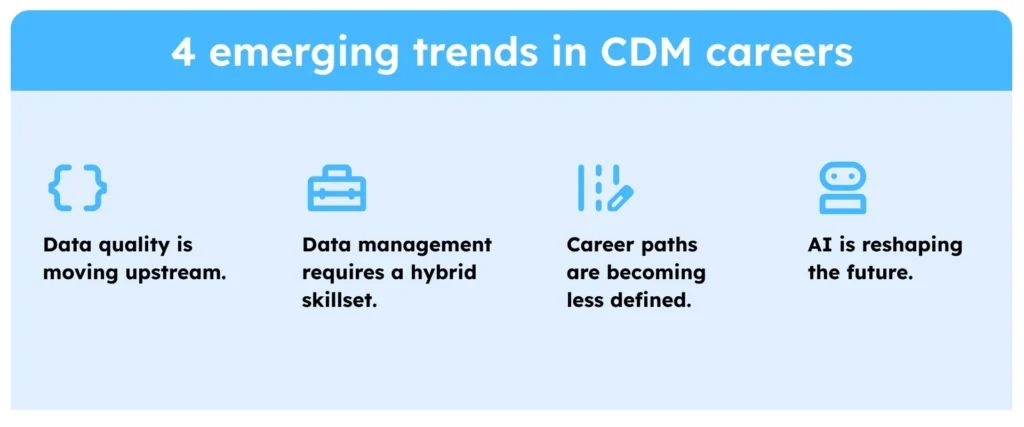
Report finding: AI is reshaping the future
AI is now part of nearly every conversation about clinical data management. Most teams expect AI to play a major role—but few agree on what exactly that role looks like.
According to interview responses, adoption varies widely between organizations. Some teams are actively experimenting with AI. Others are cautious of AI tools or avoid using them altogether, especially in regulated environments.
The data shows three competing views of AI’s impact:
- A source of efficiency
- A threat
- An unreliable but useful tool
Why it matters
Adoption may be uneven, but it will continue to progress. Professionals will need to understand how to use AI, validate outputs, and decide where human review matters. In clinical trial research, that judgment is not optional.
The real career risk is using AI without enough context. Skilled professionals know the protocol, data lineage, and quality requirements behind each output. That knowledge helps them catch gaps before AI tools turn small errors into study-level risk.
Rod gave an example of what this looks like in reality. “AI can help with Python or R programming—but data managers still need to understand what the output means.”
As AI takes hold, some execution work may disappear. The tasks that once helped people learn the field may become less available as they become automated. Clinical trial data management professionals will need to build a foundational understanding more intentionally.
What respondents said
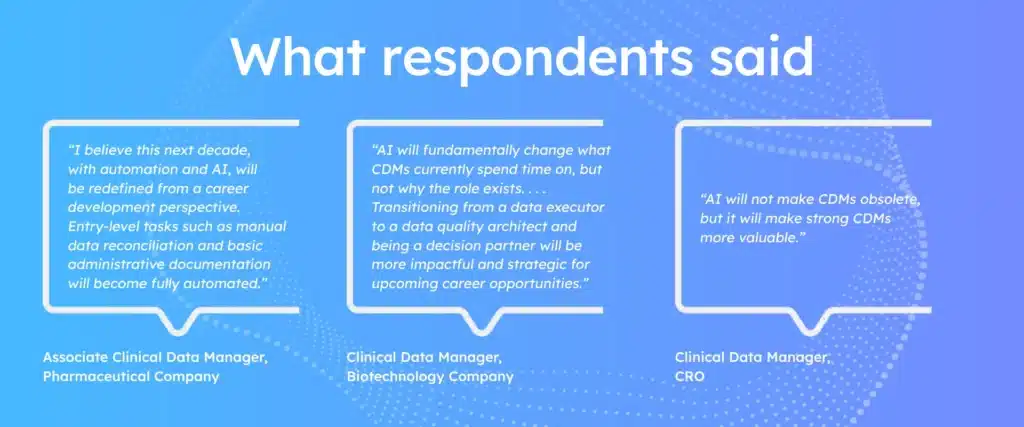
“I believe this next decade, with automation and AI, will be redefined from a career development perspective. Entry-level tasks such as manual data reconciliation and basic administrative documentation will become fully automated.” – Associate Clinical Data Manager, Pharmaceutical Company
“AI will fundamentally change what CDMs currently spend time on, but not why the role exists. . . . Transitioning from a data executor to a data quality architect and being a decision partner will be more impactful and strategic for upcoming career opportunities.” – Clinical Data Manager, Biotechnology Company
“AI will not make CDMs obsolete, but it will make strong CDMs more valuable.” – Clinical Data Manager, CROation workflows needed to keep the trial master file complete and inspection-ready.
Want to find out how to learn to work with AI in your career? Grab your copy of the actionable report.
Report finding: Data management now requires a hybrid skill set
According to interview responses, clinical data management is becoming a more technical, hybrid career. Professionals are expected to work across analytics, programming, systems, and operations.
Dashboards and reporting tools came up as a practical marker of how the role is changing. A shift that puts more responsibility on professionals to understand how data moves, how reports are built, and what the outputs mean. Many respondents also mentioned the need for more technical fluency and broader study support.
The research highlights three evolving skill sets defining the role:
- Advanced data visualization
- Technical fluency
- Proactive study support
Why it matters
This does not mean every data manager must become a full data scientist. But it does mean the role is expanding across disciplines.
Jack Cornwall, Principal Solutions Consultant at Medrio, framed it as an evolution. According to him, clinical trial data management professionals “now need to know how to create dashboards, pull reports, and use other reporting platforms.” He added that many teams combine systems, so professionals must understand how the tools work together.
Muhammad Bilal, VP of Clinical Data Services at Medrio, shared a similar view. He noted that before flexible EDC systems, companies often relied on EDC programmers. Now, a data manager is often expected to configure a study and learn reporting tools more directly.
What respondents said
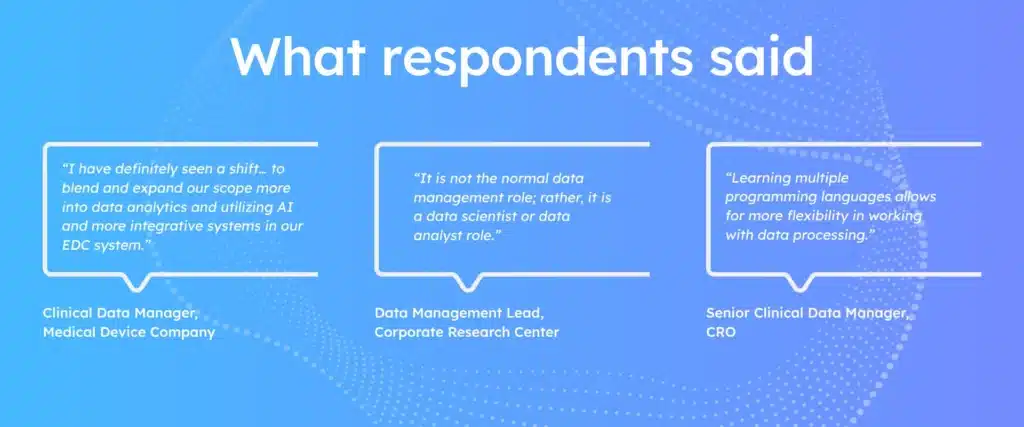
“I have definitely seen a shift… to blend and expand our scope more into data analytics and utilizing AI and more integrative systems in our EDC system.” — Clinical Data Manager, Medical Device Company
“It is not the normal data management role; rather, it is a data scientist or data analyst role.”— Data Management Lead, Corporate Research Center
“Learning multiple programming languages allows for more flexibility in working with data processing.” — Senior Clinical Data Manager, CROeams can bring study operations, clinical data, and essential documentation closer together.
Download the report to learn how to protect your career with an expanded skillset.
Want the Blueprint to a Futureproof Career?
Clinical data management may be evolving, but the core purpose has not changed. Professionals still help teams collect the right data, maintain data quality, and prepare data for analysis. What is changing is the way that work gets done.
Download the full report to:
- Build a clear plan for your career. We went straight to the source by interviewing 63 of your peers to find out exactly what separates the thriving from the stagnant.
- Get the step-by-step checklist. The report includes career actions, broken down by frequency. The suggestions are based on feedback from successful peers who have advanced in their careers.
- Learn about the two trends you’ve heard nothing about. We briefly mentioned two trends above, but the report unpacks all four in detail.
Download the CDM report now to get the full checklist and uncover the trends that will define the next decade.